Paper Flower Wall Decor: Layout, Sizes and Hanging
Plan a paper flower wall before making a single flower: how big the group should be, which mix of sizes to use, four layouts and how to hang them on different surfaces.
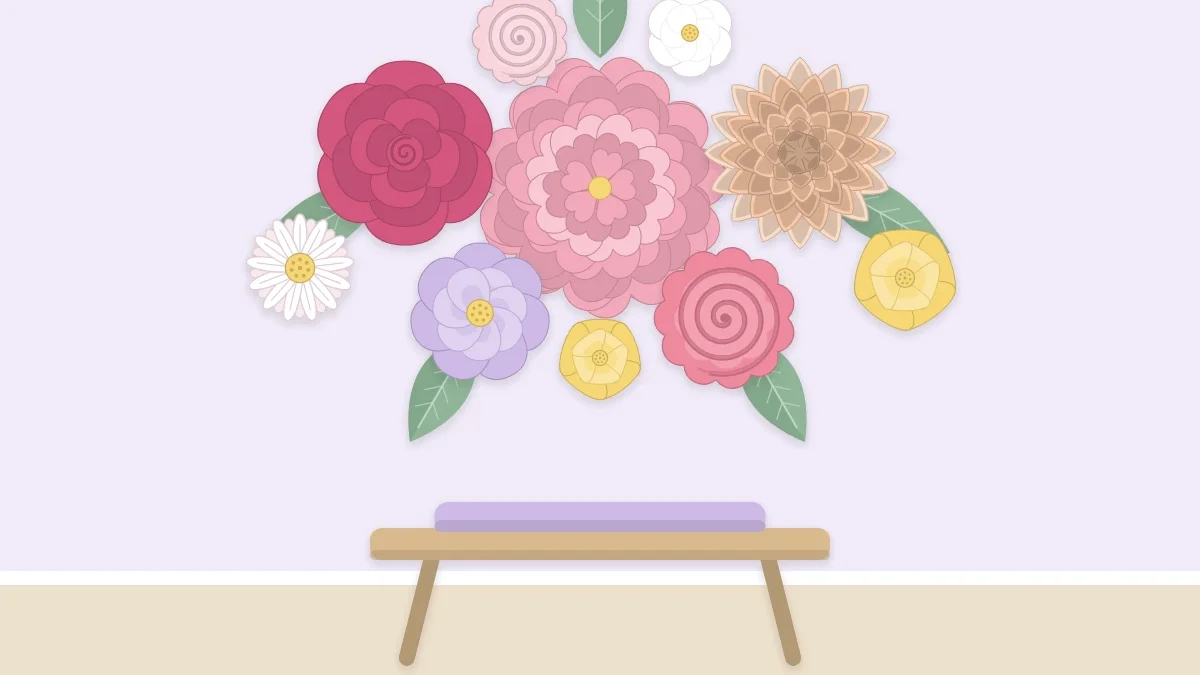
Paper flower wall decor works best when the layout is decided before anything touches the wall. The flowers themselves are the easy part. What makes a wall look planned instead of scattered is the mix of sizes, the outline of the group and a hanging method that suits the surface. This guide goes through those three in order.
Start with the wall, not the flowers
Measure the space the flowers will fill, not the whole wall. Above furniture, a group usually looks comfortable when it spans about two thirds of the furniture’s width and starts 6 to 10 inches (15 to 25 cm) above it. Above a bench 48 inches (120 cm) wide, for example, that means a group about 32 inches (80 cm) across.
Mark the area lightly with low-tack painter’s tape. Living with a tape outline for a day is a cheap way to find out whether the group is too high, too small or off-center before making twenty flowers.
Choose a mix of sizes
A wall of identical flowers reads as a pattern. A wall with three sizes reads as a composition, with the large flowers as anchors and the small ones as punctuation.
| Size | Diameter (starting point) | Job on the wall | Share of the group |
|---|---|---|---|
| Large | 12 to 16 in (30 to 40 cm) | Anchor; placed first | About 1 in 6 |
| Medium | 8 to 10 in (20 to 25 cm) | Connects anchors | About 2 in 6 |
| Small | 4 to 6 in (10 to 15 cm) | Fills gaps, trails off at the edges | About 3 in 6 |
For the 32 inch (80 cm) group above, a reasonable first plan is 2 large, 4 medium and 6 small flowers, plus 8 to 10 leaves. Large blooms can be built with the method for giant cardstock flowers; for medium flowers with a lot of texture, a cone-petal paper dahlia casts strong shadows on a wall.
Depth matters as much as width
Wall flowers need flat backs. A flower that sticks out more than about 4 inches (10 cm) gets bumped in hallways and pulls harder on its fixing. Keep deep flowers for spots above furniture, where nobody brushes past.
Four layouts that work
Crescent
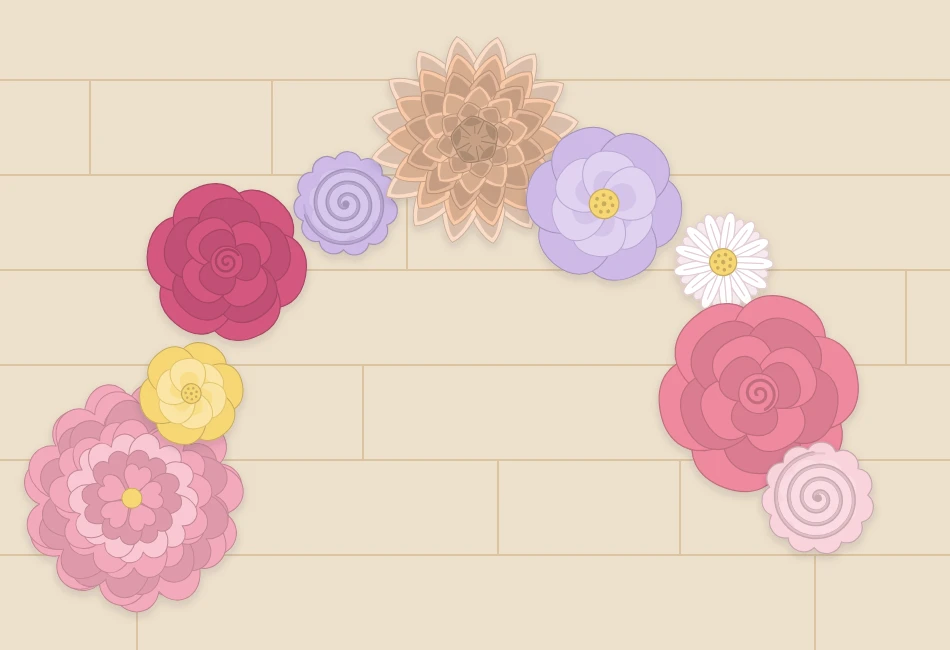
Flowers follow a curved line like a shallow C or a tilted moon, densest in the middle and thinning to small flowers and leaves at both tips. It suits the space above a bench, bed or console and needs the fewest flowers for its impact.
Loose cluster
One large flower slightly off-center, with others grouped around it and touching or overlapping. The outline is irregular on purpose. Good for narrow walls and entryways.
Corner cascade
The group starts dense in an upper corner and falls diagonally, getting smaller and sparser. It works beside a mirror, a door frame or a headboard.
Full backdrop
Flowers cover a whole panel edge to edge, typically for a party or photo spot. It needs far more flowers than expected: plan on large flowers nearly touching, with medium and small ones covering every gap. For a temporary backdrop, mounting flowers on foam board panels is easier than fixing each one to the wall.
Rehearse the layout on the floor
Lay a sheet or kraft paper on the floor and mark the wall area on it. Then place the flowers in this order:
- Large flowers first. Set them off-center and at different heights, never in a straight row.
- Medium flowers next. Use them to link the large ones along the line of the layout.
- Small flowers and leaves last. Fill gaps and let them trail off at the ends.
- Check the spacing. Flowers that nearly touch read as one group. Gaps wider than a small flower read as separate decorations.
- Record it. Take a photo from directly above. If kraft paper is underneath, trace around each flower so the paper can be taped to the wall as a placement map.
Pick a hanging method for the surface
Paper flowers are light, so strong fixings are rarely needed. What matters is whether the method can be removed without damage.
| Surface | Method to try | Keep in mind |
|---|---|---|
| Painted drywall in good condition | Removable adhesive mounting strips or reusable mounting putty | Test one flower in a hidden spot for a few days first |
| Fresh, flaking or matte chalky paint | Small pins or thin nails with a loop on the flower back | Adhesives can lift this kind of paint |
| Wallpaper | Clear thread from a picture rail or ceiling hooks | Avoid adhesive directly on wallpaper |
| Tile, glass, mirror | Removable adhesive strips or putty | Wipe the surface clean and dry first |
| Brick or rough plaster | Mount flowers on a painted board, then hang the board | Putty and strips do not grip rough surfaces well |
| Rental or event venue | Foam board panels or a freestanding frame | Ask what is allowed before fixing anything |
To give a flower something to hang from, glue a cardstock circle to the back and attach the strip, putty or thread loop to that, not to the petals.
Watch out
Do not hang heavy or wired flowers directly above a crib or a bed pillow, and keep all paper decor away from candles, heaters and bare bulbs. Use a stable step stool for high placements.
Hang from the middle outward
Fix the large flowers first, using the photo or paper map. Step back after each one. Then add the medium flowers, and finish with the small ones and the leaves, which can slide partly behind petals to hide any visible backing. If a flower sits slightly wrong, move it now; strips and putty reposition most easily in the first few minutes.
Smaller ways to decorate a wall
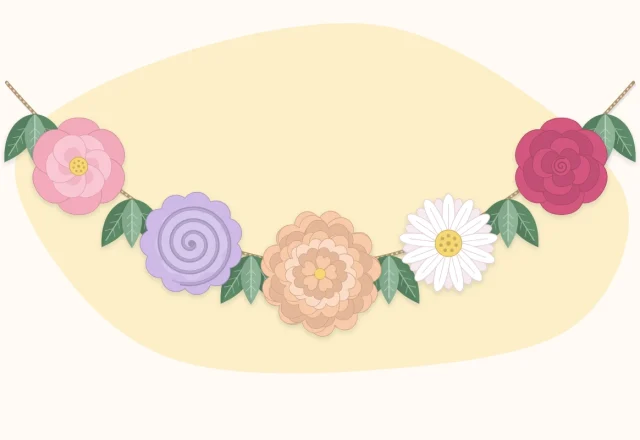
A full cluster is not the only option. A single large flower above a desk, three medium flowers in a diagonal line or a paper flower garland draped across a shelf uses the same ideas with far less work.
Living with a flower wall
Direct sunlight fades colored paper, sometimes unevenly, so a wall beside a bright window is not the best place for deep pinks and reds. Steam from kitchens and bathrooms softens petals. Dust the flowers gently now and then; the guide to caring for paper flowers explains how, and how to pack them flat if the wall is seasonal.
Frequently asked questions
How many paper flowers are needed for a wall?
It depends on the area. As a starting point, a group about 32 inches (80 cm) wide above a bench uses around 2 large, 4 medium and 6 small flowers plus leaves. A full backdrop needs many more, with flowers nearly touching.
How can paper flowers be hung without damaging the wall?
On sound painted walls, removable adhesive mounting strips or reusable putty are usually enough because the flowers are light. Test one flower in a hidden spot first, and avoid adhesives on wallpaper or flaking paint.
What size should paper flowers be for wall decor?
A mix of three sizes works well: large flowers of 12 to 16 inches, medium of 8 to 10 inches and small of 4 to 6 inches, with more small flowers than large ones.