Paper Flower Wreath: A Step-by-Step Door Decoration
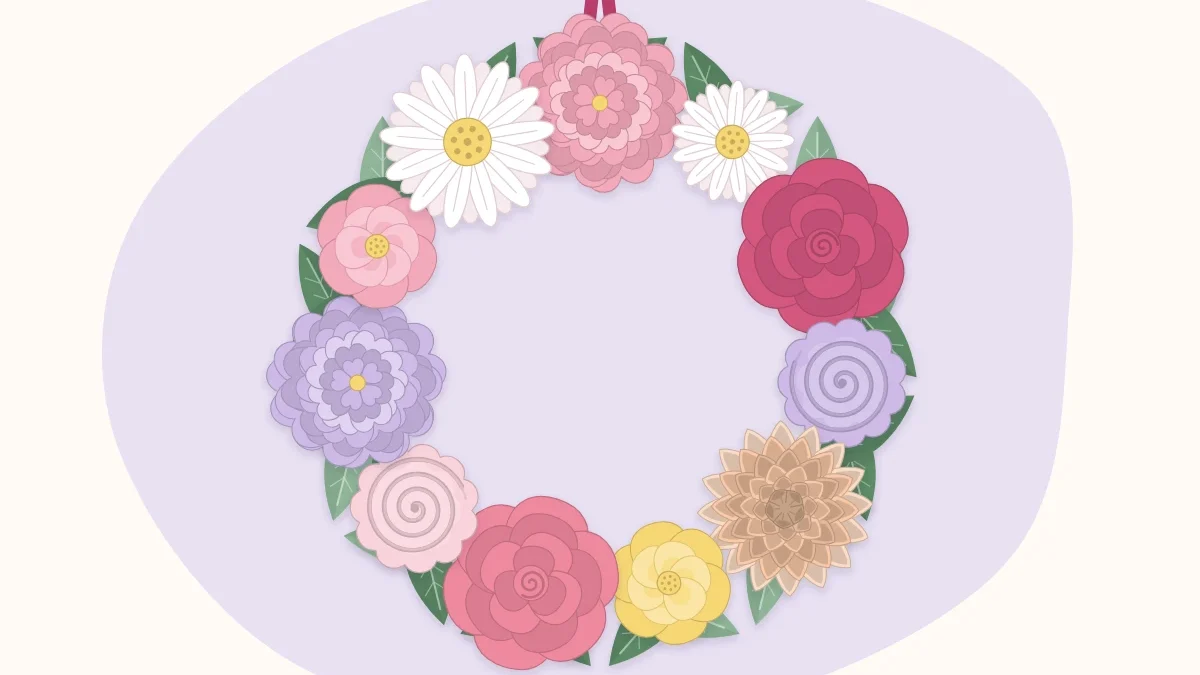
Choose a wreath base, plan a balanced layout and attach paper flowers cluster by cluster. Sizes and counts are starting points for a 12 inch ring.
Tutorial at a glance
- Difficulty Easy
- Estimated time About 1 to 2 hours, plus time to make the flowers
- Recommended paper 65 lb (about 176 gsm) cardstock for flat-backed flowers and leaves
Materials
- Wreath base about 12 inches (30 cm) across: doubled cardboard ring, hoop or twig ring
- 3 large, 5 medium and 6 to 8 small paper flowers
- 12 to 15 paper leaves in two shades of green
- Low-temperature hot glue gun or tacky craft glue
- Green floral tape and thin floral wire (for a hoop base)
- 8 inches (20 cm) of ribbon or twine for hanging
- Scissors
A paper flower wreath is mostly an assembly job: the flowers can be any simple style you already know, and the work is in choosing a base, grouping the flowers so the ring looks balanced, and attaching everything so it survives a door opening and closing. The sizes and counts below are starting points for a 12 inch (30 cm) wreath. Scale them up or down to suit your door.
Pick a base first
The base decides how the flowers attach and how heavy the finished wreath will be. Three common options work well with paper.
| Base | Good for | How flowers attach | Keep in mind |
|---|---|---|---|
| Corrugated cardboard ring, cut by hand | Flat-backed cardstock flowers, fully covered wreaths | Glue directly to the surface | Cheapest and lightest; must be completely hidden or painted |
| Metal or wooden hoop | Airy, partly covered designs | Wired stems wrapped around the hoop, then taped | The bare part of the hoop stays visible, so choose a finish you like |
| Grapevine or twig ring | Rustic looks, crepe paper flowers on stems | Stems tucked between twigs, with a dot of glue | Heavier, and rough twigs can snag delicate paper |
For a cardboard ring, trace a 12 inch (30 cm) dinner plate or lid, then trace a smaller circle inside it to leave a band about 2 inches (5 cm) wide. Cut two identical rings and glue them together with the corrugation running in different directions; the doubled ring resists bending much better than a single layer.
Materials
- One wreath base, about 12 inches (30 cm) across
- 3 large flowers, roughly 4 inches (10 cm) wide
- 5 medium flowers, roughly 3 inches (7.5 cm) wide
- 6 to 8 small filler flowers, 1.5 to 2 inches (4 to 5 cm) wide
- 12 to 15 paper leaves in two shades of green
- Low-temperature hot glue gun or tacky craft glue
- Green floral tape and thin floral wire, if you are using a hoop
- 8 inches (20 cm) of ribbon or twine for the hanging loop
Recommended paper: 65 lb (about 176 gsm) cardstock makes sturdy flat-backed flowers that glue cleanly to a ring. Flowers that roll up from a single piece are a good match, so the spiral-cut rolled roses work well as the medium and small sizes, and a few quick layered daisies add a different shape without adding much time.
Decide on the layout before any glue
Lay the base flat on the table and arrange the loose flowers on top. Two layouts are easy to get right:
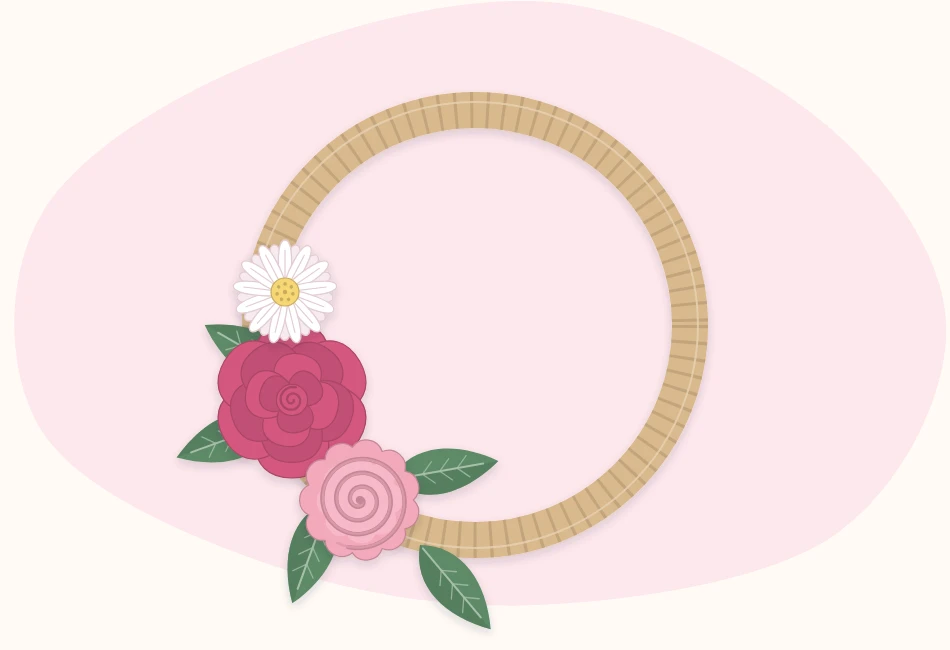
- Crescent: flowers cover about half to two thirds of the ring, thickest at the center of the curve and tapering to single leaves at both ends. This needs fewer flowers and suits a hoop.
- Full ring: flowers cover the whole base. Space the three large flowers unevenly, like the points of a lopsided triangle, so the wreath does not look like a clock face.
Take a quick photo of the arrangement you like. It is much easier to rebuild from a photo than from memory once the pieces are moved aside.
Build the wreath
- Attach the hanging loop. Tie the ribbon into a loop and glue or knot it to the back of the base at the top. Doing this first means you never have to flip a finished wreath face down.
- Cover or color the base. If any of a cardboard ring might show, paint it or wrap it in paper strips in a color close to your leaves. Let it dry fully.
- Lay the first leaves. Glue four or five leaves where the first cluster will sit, with their tips pointing outward and slightly along the curve of the ring. Leaves go on first so they sit under the flowers and frame them.
- Place the first large flower. Apply glue to the flat back of the flower, press it onto the base, and hold for several seconds. Let it overhang the outer edge of the ring a little so the base is hidden.
- Add two neighbors. Glue one medium flower and one small flower tight against the large one, at slightly different heights across the width of the ring. Petals should touch or overlap; gaps are what make a wreath look sparse.
- Repeat cluster by cluster. Work around the ring in the same order: leaves, large or medium flower, then smaller flowers. Keep checking against your photo.
- Fill the gaps. Hold the wreath upright at arm’s length. Wherever base shows through, tuck in a small flower or a folded leaf.
- Check the back. Trim glue strings and any wire ends, and bend cut wire tips flat against the base so they cannot scratch the door.
Watch out
Hot glue burns, even from a low-temperature gun. Press pieces down with a craft stick or the eraser end of a pencil instead of a fingertip, and keep the gun on a stand between uses. With children, switch to tacky craft glue and allow extra drying time.
Working on a hoop instead
Flowers for a hoop need short wire stems. Hold a stem along the hoop, wrap it with thin wire two or three times, then cover the join with floral tape, stretching the tape as you go so it grips. The guide to wiring and taping stems covers the wrapping motion in detail. Point all the stems the same way around the hoop so each new flower hides the stem of the one before it.
Where a paper wreath can hang
Paper and weather do not mix. Rain, damp air and direct sun will soften, warp and fade a wreath quickly, so the safest spots are indoors: the inside of a front door, an interior door, a mirror, or a wall above a mantel. An exterior door is realistic only when it is well sheltered, for example behind a storm door or deep under a covered porch, and even then it is best treated as a short-term display. Keep any paper wreath well away from candles, fireplaces and hot light bulbs.
If something looks off
- The wreath tips to one side on the hook. One side is heavier. Slide the hanging loop a little toward the heavy side, or add a flower opposite it.
- It looks flat. Lift a few petals and curl their edges, and glue two or three small flowers on top of the joins between larger ones to add a second layer.
- Flowers pop off. Glossy or coated cardstock does not hold glue well. Rough up the contact spot with a fingernail or fine sandpaper, then re-glue.
- The ring bends. Glue a third cardboard ring to the back, or a few craft sticks across the weakest points.
Easy variations
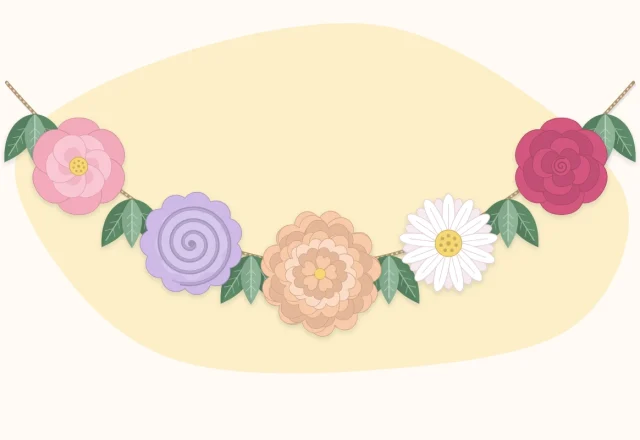
Changing the color scheme changes the season: whites and greens for winter, bright mixed colors for spring, golds and rusts for fall. A wreath made entirely of one flower type in three shades of a single color looks calm and deliberate. For a longer decoration built from the same flat-backed flowers, the same clusters can be spaced along twine to make a matching flower garland.
Frequently asked questions
Can a paper flower wreath hang on an outside door?
Only if the door is well sheltered, such as behind a storm door or deep under a covered porch, and even then as a short-term display. Rain, damp air and direct sun soften, warp and fade paper, so indoor spots are the safest.
How many paper flowers does a 12 inch wreath need?
As a starting point, plan on about 3 large, 5 medium and 6 to 8 small flowers plus 12 to 15 leaves for a fully covered 12 inch (30 cm) ring. A crescent layout that covers half to two thirds of the ring needs fewer.
What glue works best for a paper flower wreath?
Low-temperature hot glue grabs quickly and suits cardstock flowers on a cardboard base. Tacky craft glue also works and is the safer choice when crafting with children, but each flower needs to be held or propped while it sets.