Paper Flower Materials and Tools: A Beginner’s Checklist
A staged checklist of paper flower supplies: what a first flower needs, what to add for stems and crepe paper, and which tools can wait.
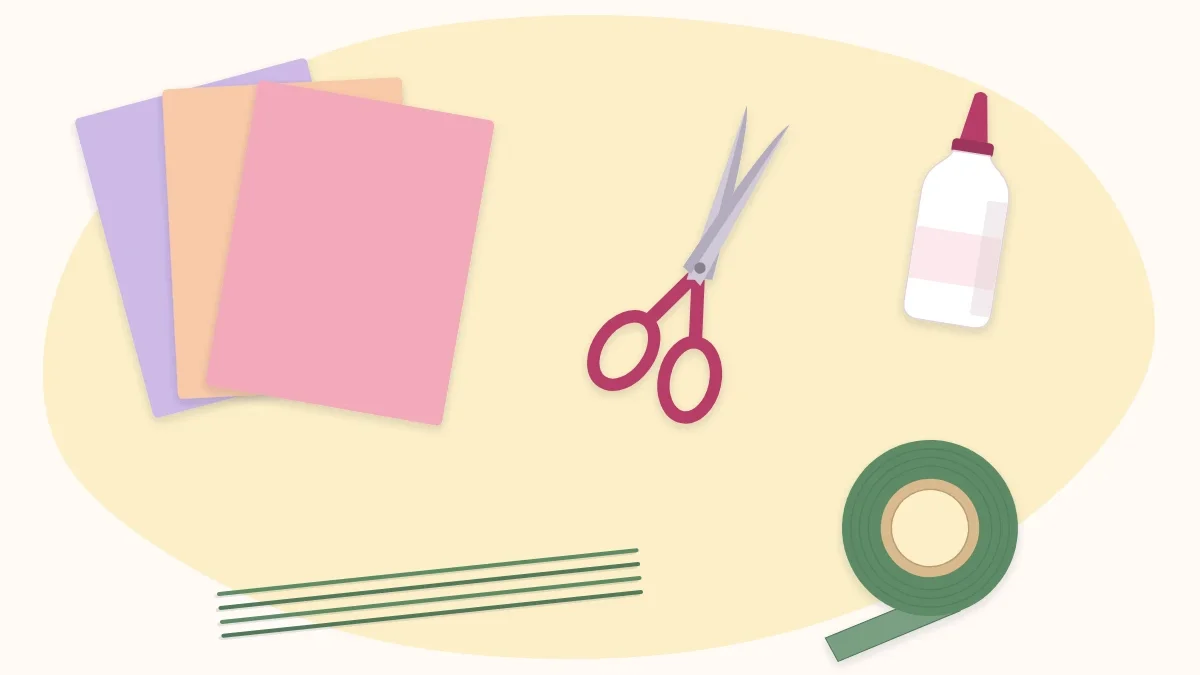
You can make a good paper flower with scissors, glue and a few sheets of paper. Everything beyond that either adds a stem, speeds up repetitive work, or helps with one particular style of flower. The lists below are sorted by when each item becomes useful, so nothing needs to be bought before it has a job.
The starter kit: enough for a first flower
- Paper. A small pack of 65 lb (176 gsm) cardstock in a few colors, including one green and one yellow or brown for centers. Ordinary colored printer paper also works for rolled and folded flowers.
- Scissors. One sharp pair with blades around 5 to 6 inches (13 to 15 cm) long. Sharpness matters far more than type.
- Tacky craft glue. Thicker than school glue, so petals stay where they are put instead of sliding.
- A pencil and eraser. For tracing templates lightly on the back of the paper.
- A shaping stick. A wooden skewer, a round pencil or a knitting needle for curling petal tips.
- Something round to trace. Jar lids and glasses stand in for a compass.
That is the whole list for daisies, rolled roses and other flat flowers. If the choice of paper feels like the confusing part, the guide to choosing paper by type and weight covers it on its own.
Add these when you want stems
A flower on a stem can go in a vase or a bouquet, and it needs three more things.
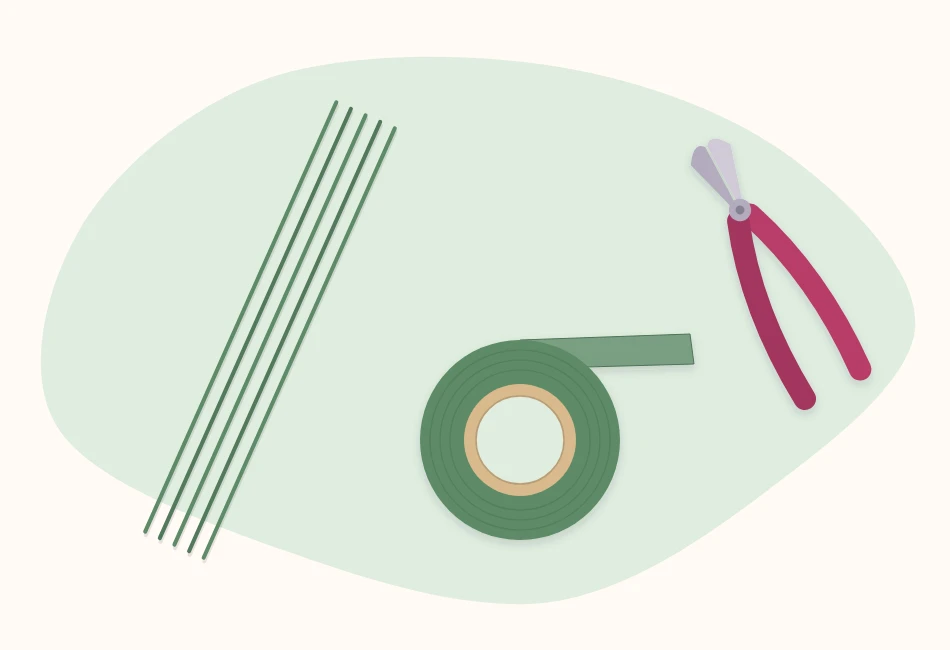
Floral wire
Wire is sold by gauge, and the numbering runs backward: a lower number means a thicker wire. Three gauges cover most needs.
| Gauge | Feel | Typical use |
|---|---|---|
| 18 gauge | Stiff, holds a heavy head | Main stems for roses, sunflowers, peonies |
| 20 to 22 gauge | Firm but bendable | Stems for small flowers, sturdy leaves |
| 24 to 26 gauge | Thin and flexible | Leaf veins, binding petals, fine details |
Pre-cut lengths of about 18 inches (46 cm) are easier to handle than a coil, and paper-covered wire gives glue something to grip.
Floral tape
Floral tape is not sticky on the roll. It is a waxy crepe ribbon that becomes tacky when stretched, so it has to be pulled gently as it is wrapped. One roll of green handles most projects; brown or white are useful later for branches and wedding work.
Wire cutters
Cutting wire with craft scissors notches the blades, and a notched blade snags paper from then on. A small pair of wire cutters, or the cutting jaw on a pair of pliers, protects the scissors.
How to use all three together is covered in the guide to wrapping stems and adding leaves.
Add these when you move to crepe paper
- Heavy crepe paper, around 180 gsm. It stretches a long way and holds a cupped shape. Two or three flower colors and one green are enough to begin.
- Fine crepe paper, around 60 gsm. Softer and more delicate, for small petals and ruffled edges. Not needed at first.
- A second pair of scissors. Crepe dulls blades slowly, and many crafters keep one pair for paper and one for everything else.
Helpful extras that can wait
| Item | What it does | Worth it when |
|---|---|---|
| Low-temperature glue gun | Bonds in seconds | Building large or many-petaled flowers, where holding each petal gets tiring |
| Self-healing cutting mat and craft knife | Cuts slits and inside curves cleanly | Templates include details scissors cannot reach |
| Bone folder or scoring tool | Presses a fold line before folding | Heavy cardstock cracks along folds |
| Ball stylus and foam pad | Presses a cup into small cardstock petals | Making blossoms with small rounded petals |
| Fringe scissors | Cut several parallel snips at once | Making many fringed centers |
| Chalk pastels or a soft ink pad | Add a blush of color to petal edges | Flowers look flat in one solid color |
| Small clips or clothespins | Hold glued pieces while they set | Any time, since they free up both hands |
Tip
Before buying a tool, make the flower once without it. If a step was awkward or slow, the tool has earned its place. If not, the money is better spent on more paper.
Which glue for which job
Glue causes more frustration than any other material, usually because the wrong one is in use.
- Tacky craft glue is the everyday choice. It grabs in a few seconds, dries clear and leaves time to adjust a petal.
- Glue stick suits flat layers such as a center disc on a daisy. It is too weak for curved petals under tension.
- Hot glue is fastest and strongest on bulky joins, but it leaves strings and visible lumps on thin paper.
- School glue works, slowly. Its extra water can warp thin paper and make crepe colors bleed.
Things you probably already own
Several useful tools are already in most homes: a ruler, toothpicks for placing tiny dots of glue, a damp cloth for fingers, a shallow dish to hold cut petals, scrap paper to protect the table, and thin cardboard from a cereal box for making reusable templates. A cardboard template can be traced dozens of times, and the full method is in the guide to cutting petals from templates and stacks.
What to skip at the start
Electronic cutting machines, large die sets and specialty papers are not needed to learn. They solve a volume problem, cutting hundreds of identical petals, that a beginner does not have yet. Hand cutting also teaches how petal shapes work, which makes later templates easier to adapt.
Storing supplies
Keep cardstock flat, crepe paper in its folds and away from direct sun, and wire in a tube or tall jar so the ends are not loose in a drawer. Floral tape dries out over time, so a sealed bag extends its life. Cap glue tightly and store bottles upside down if the nozzle clogs often.
Watch out
Cut wire ends are sharp. Trim them over a container, bend exposed tips back with pliers, and keep wire, cutters and glue guns out of reach of small children.
Frequently asked questions
What is the minimum needed to make a paper flower?
Paper, sharp scissors and tacky craft glue. A pencil for tracing and a skewer for curling petals help, and both are usually already at home.
Is a hot glue gun necessary for paper flowers?
No. Tacky craft glue handles most flowers. A low-temperature glue gun mainly saves time on large or many-petaled flowers, and it needs care because the glue and nozzle can burn.
What gauge of floral wire should a beginner buy?
A pack of 18 gauge wire for main stems and a pack of 24 or 26 gauge wire for leaves and binding covers most beginner projects. A lower gauge number means a thicker wire.