How to Make Crepe Paper Tulips with Cupped Petals
Six deeply cupped petals, a padded stem and long clasping leaves are all a crepe paper tulip needs. Starting sizes, assembly steps and fixes included.

Tutorial at a glance
- Difficulty Easy
- Estimated time About 30 minutes per tulip
- Recommended paper Heavy 180 gsm crepe paper
Materials
- Heavy 180 gsm crepe paper in petal colors
- Green heavy crepe paper for leaves
- Scrap of yellow or pale green crepe paper
- 18-gauge floral wire, about 14 inches (36 cm) per tulip
- Green floral tape
- Paper towel or scrap crepe for padding the stem
- Tacky craft glue
- Scissors and wire cutters
Crepe paper tulips need only six petals each, which makes them one of the fastest realistic crepe flowers to build. The whole look comes from one move: stretching each petal into a deep cup so the six of them close into the familiar egg-shaped bloom. Make one to learn the shape, then make a handful, because tulips look best in a bunch.
The tulip at a glance
- Petals: six, arranged as an inner three and an outer three
- Center: a small wrapped nub of pale green or yellow crepe
- Stem: thicker and smoother than most flower stems, with a gentle curve
- Leaves: one or two long, broad blades that clasp the stem low down
Looking at photographs of real flowers before starting helps with proportion and color. The RHS tulip guide shows the range, from slim, pointed blooms to rounded goblets.
What you need
Heavy 180 gsm crepe paper is the recommended choice here. A tulip petal has to hold a deep cup on its own, with no neighbors propping it up, and heavy crepe keeps that shape. For three tulips, gather:
- Heavy crepe paper in one to three petal colors
- Green heavy crepe paper for leaves
- A scrap of yellow or pale green crepe for the centers
- Three 18-gauge floral wires, about 14 inches (36 cm) long
- Green floral tape
- A strip of paper towel or scrap crepe for padding the stems
- Tacky craft glue, scissors and wire cutters
Step 1 to 4: Prepare six petals
- Cut a petal strip. Cut a strip of crepe 2.75 inches (7 cm) tall, with the grain running up and down the height. A strip about 11 inches (28 cm) long gives six petals.
- Cut the petal shape. Fold the strip into six layers, each about 1.75 inches (4.5 cm) wide. Cut an egg shape through the stack: widest just below the middle, coming to a soft point at the top, and narrowing to about half an inch (1.3 cm) at the base.
- Cup each petal. Place both thumbs in the lower middle of a petal and pull slowly outward. Stretch more than feels necessary; the petal should curve like the bowl of a spoon. Leave the top quarter inch (6 mm) unstretched so the tip stays neat.
- Pinch the tip. Pinch the very top of each petal lightly between two fingers to give it a faint center crease and a slight inward lean.
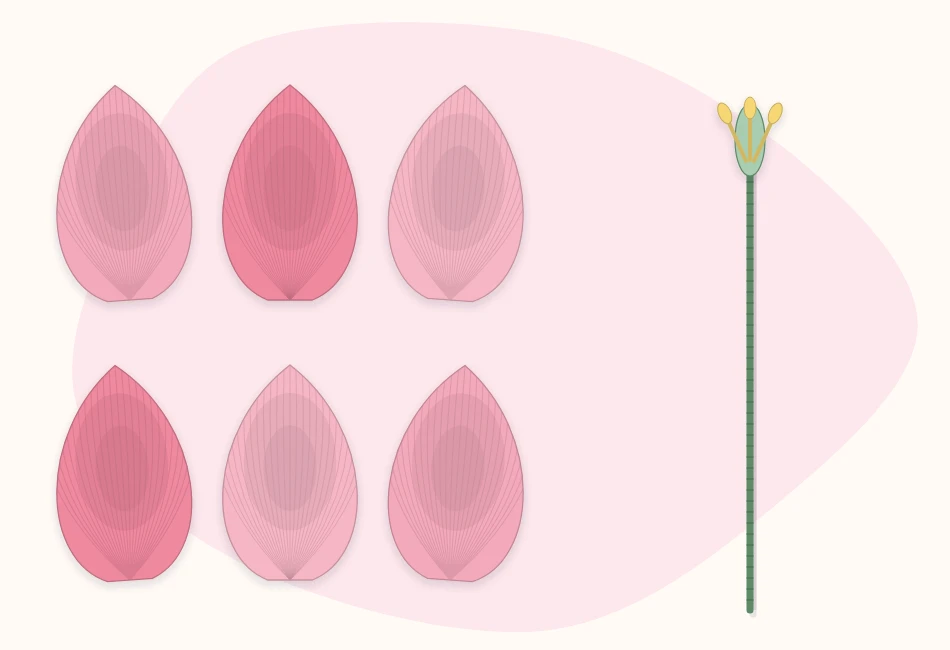
The same thumb-stretch cupping is used for many other flowers. If the motion feels awkward, the guide to curling, cupping and creasing petals breaks it down further.
Step 5 to 8: Assemble on the stem
- Make the center. Cut a strip of yellow or pale green crepe about 1 inch tall and 2 inches long (2.5 x 5 cm). Glue along one long edge and wrap it around the top of the wire to form a small nub about the size of a pea pod tip.
- Attach the inner three. Put glue on the bottom half inch of a petal and press it to the wire just under the center, cup facing in. Add two more, spacing them evenly so they form a triangle when viewed from above. Their edges should just touch or slightly overlap.
- Attach the outer three. Glue each outer petal over a gap between two inner petals, at the same height. Hold the base for a few seconds while the glue grabs.
- Pad and wrap the stem. Wind a narrow strip of paper towel or scrap crepe down the wire to thicken it to roughly the width of a pencil, then cover everything with floral tape, starting over the petal bases and stretching the tape as it spirals down.
Tip
Tulips rarely stand ramrod straight. Once the stem is wrapped, bend it into one long, gentle curve by running it between thumb and fingers rather than kinking it in one spot.
Long leaves that clasp the stem
Cut each leaf from green heavy crepe as a long blade about 7 inches tall and 1.5 inches wide (18 x 4 cm), with the grain running the length of the leaf. Bring the top to a point and leave the bottom wide. Stretch the lower half very slightly across its width so it curls around the stem, then glue only the bottom inch (2.5 cm) around the stem about 4 inches (10 cm) from its base. A second, shorter leaf on the opposite side balances the flower. For stiffer leaves that can be posed, glue a thin wire along the back; the technique is covered in the guide to stems and leaves.
Open, closed or somewhere between
How the petals are set decides the stage of bloom, and mixing stages in one bunch looks more natural than six identical flowers.
| Stage | How to get it |
|---|---|
| Tight bud | Cup lightly, overlap the petals by a third, and press the tips together |
| Classic goblet | Cup deeply and let the petal edges just meet |
| Fully open | Cup deeply, then roll the top third of each petal outward over a finger |
Three problems and their fixes
The bloom looks like a flat star
The petals are under-stretched. Heavy crepe can take a firm pull; cup a spare petal as far as it will go without tearing to find the limit, then shape the rest close to it.
The petals slide down the wire
Too much wet glue is acting as a lubricant. Use a thin smear, wait a few seconds for it to turn tacky, then press. A turn of floral tape under the center also gives the petals something to grip.
The head flops forward
The stem is too thin for its length. Shorten it, or tape a second wire alongside before padding.
Watch out
Wire ends are sharp when freshly cut. Cover the bottom of each stem with a last turn of floral tape before handing a tulip to a child.
Color and display ideas
- Brush a little soft pastel dust onto the base of each petal before cupping for a deeper throat.
- Cut petals from two close shades, such as peach and coral, and alternate inner and outer rings.
- Make five or seven tulips at slightly different stem lengths so the heads sit at staggered heights.
A simple bunch needs very little arranging, but a few principles about height and spacing help. They are explained in the guide to filling a vase with paper flowers.
Frequently asked questions
How many petals does a paper tulip have?
Six. They are attached as an inner group of three, spaced evenly around the center, and an outer group of three placed over the gaps.
How do you make crepe paper tulip petals cup?
Place both thumbs in the lower middle of the petal and pull slowly outward, stretching the center while leaving the edges and tip alone. Heavy crepe paper can take a firm stretch and holds the cup well.
How do you make a thick tulip stem from wire?
Wind a narrow strip of paper towel or scrap crepe paper down the wire until it is roughly as thick as a pencil, then cover the padding with floral tape, stretching the tape as it spirals down.